
A promotional campaign might give out all its planned rewards and see high player sign-up rates, but still lose money. Simply looking at how many players claim or use an offer does not show whether those players would have played anyway, nor does it reveal the true cost of the promotion.
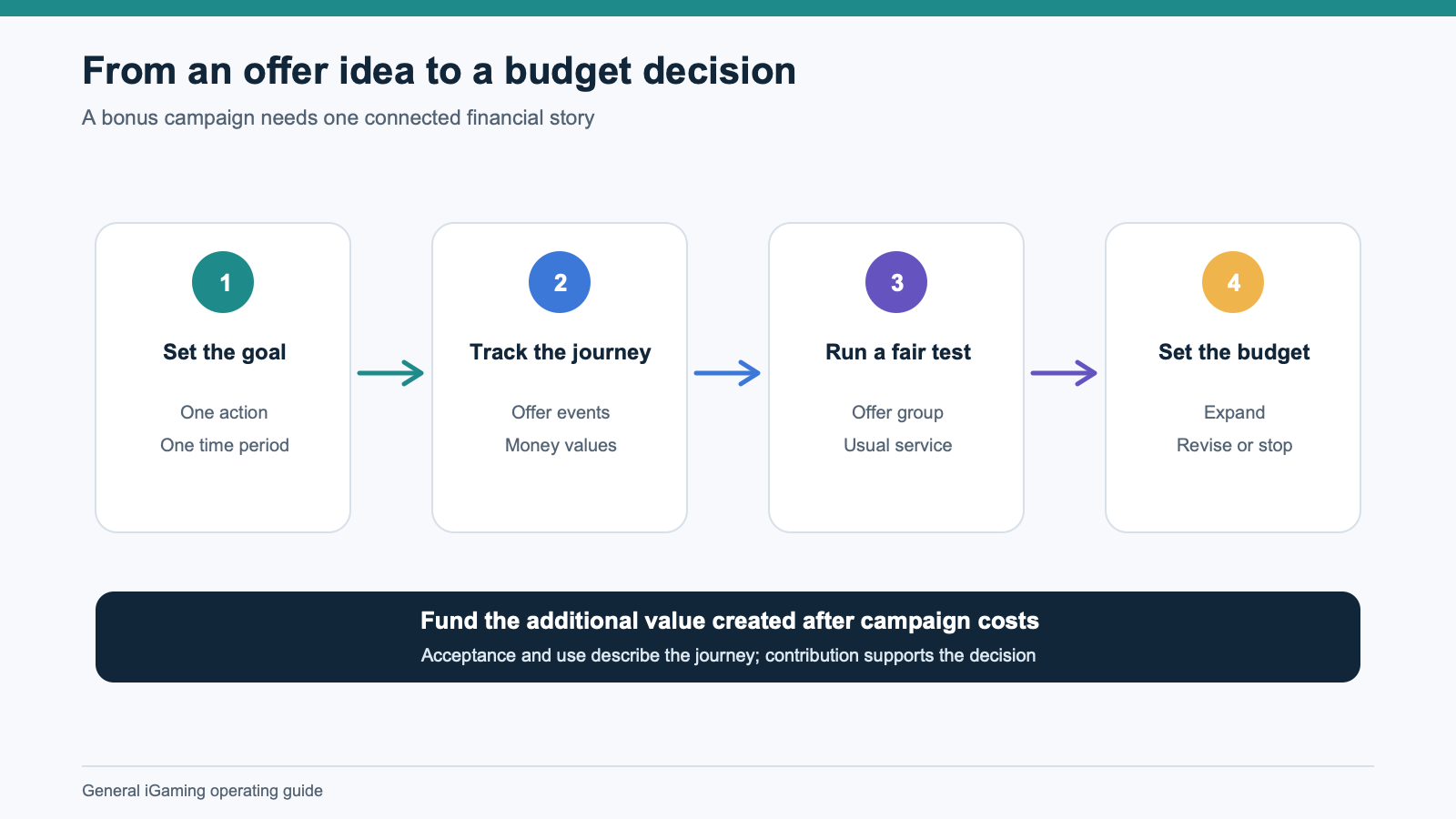
To measure real return on investment (ROI), set a clear goal and timeframe before launching. Track player activity alongside total costs, and compare a group offered the promotion against a similar group receiving normal service. Only keep funding campaigns that generate enough extra value to cover their costs.
Key takeaways:
- Set a single target action, timeframe, and financial goal for every campaign.
- Track player activity from offer claims and usage to final expenses and revenue.
- Keep bonus value, gameplay, winnings, costs, and earnings clearly separated.
- Compare against a control group to see the true extra value created by the offer.
1. Set the result before choosing the reward
Campaign planning often starts with the offer. A team chooses free spins, cashback, or a deposit match, then builds an audience around it. This order makes the reward the centre of the campaign. A stronger brief starts with the intended player action. A welcome campaign may support first play after deposit. A reload campaign may support another successful deposit. A return campaign may support another active day within a fixed period.
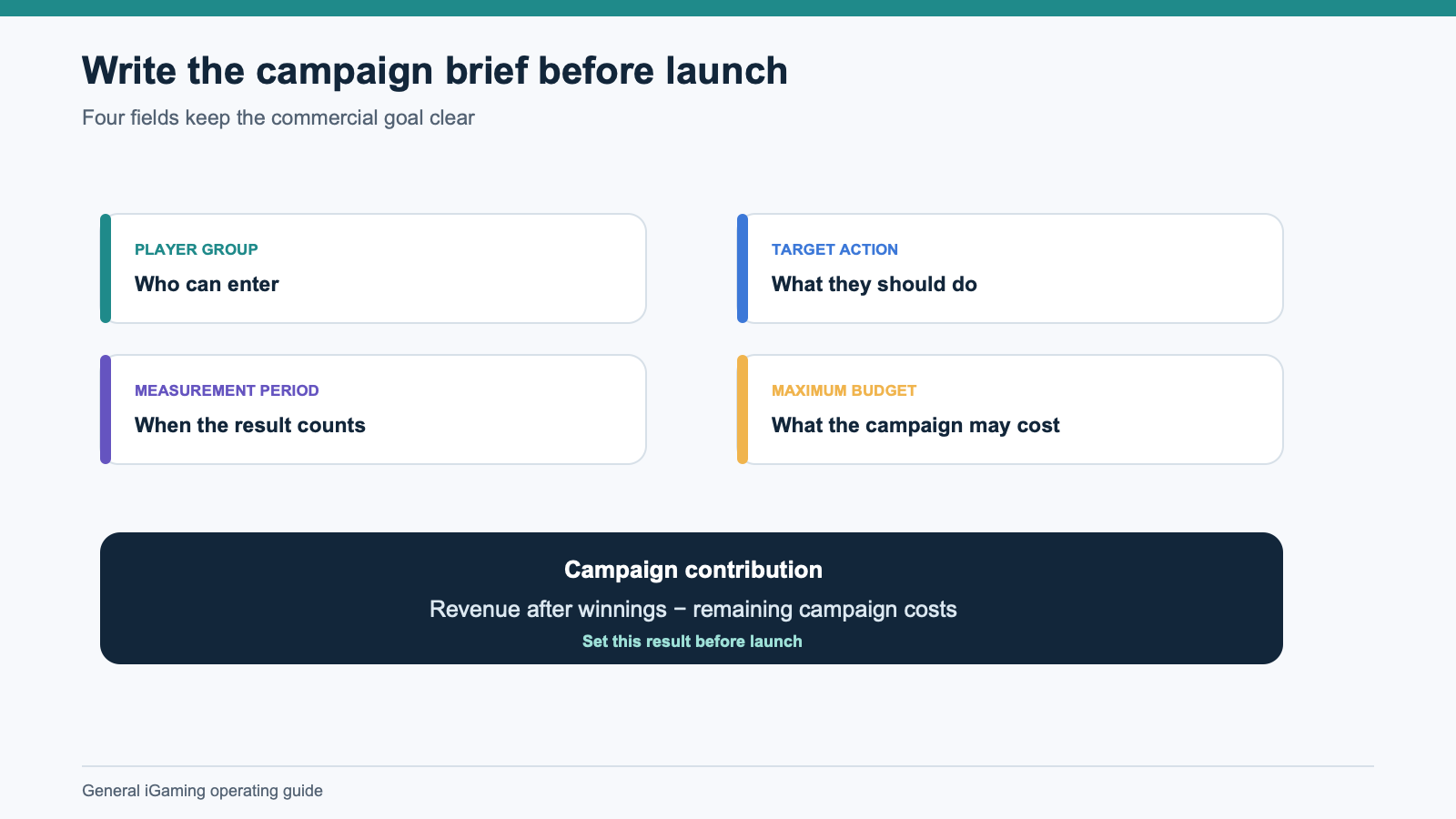
The brief should state four fields before the team selects the reward amount: the player group, the target action, the time period, and the maximum budget. It should also name one main money result. Delivery, opens, acceptance, and use can explain the journey. The chosen money result should guide the final decision.
| Campaign field | Example definition | Why it matters |
|---|---|---|
| Player group | Eligible first-time depositors | Fixes who enters the decision |
| Target action | A second active day | Gives the campaign one job |
| Measurement period | Seven days, followed by a thirty-day review | Prevents moving the finish line |
| Maximum budget | Approved reward and delivery cost | Limits financial exposure |
| Main result | Value left per assigned player | Connects activity to value |
For instance, a major online gaming company reported that its sports betting revenue margin grew from 6.0% in 2024 to 7.1% in 2025. Company leaders attributed this growth to better sports results and smarter promotion strategies. While overall company figures combine many factors and don’t prove the impact of a single promotion, they highlight why tracking campaign performance matters.
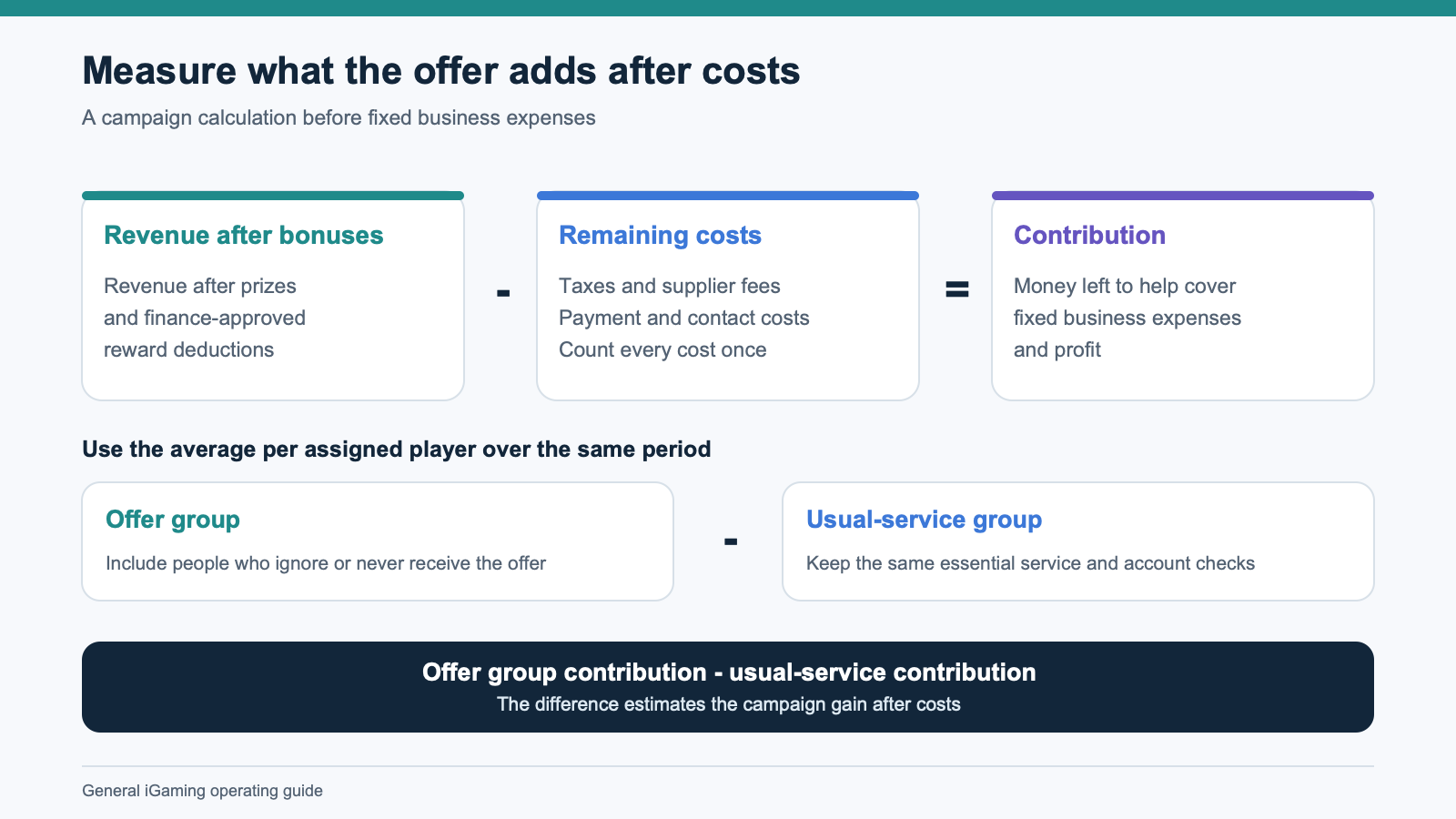
The main result should use a formula approved by finance. Start with gambling revenue after winnings and any reward deductions already included by finance. Subtract direct costs such as gaming tax, supplier charges, payment fees, messages, and service work. Count each cost once and use the same currency rules for every group. Record zero value when an assigned player creates no revenue during the period.
Deposits, accepted offers, and bonus-funded play remain useful journey measures. Each measure leaves part of the campaign cost unanswered. The operating rule is to define the money result before the team builds the reward.
2. Follow the offer and the money
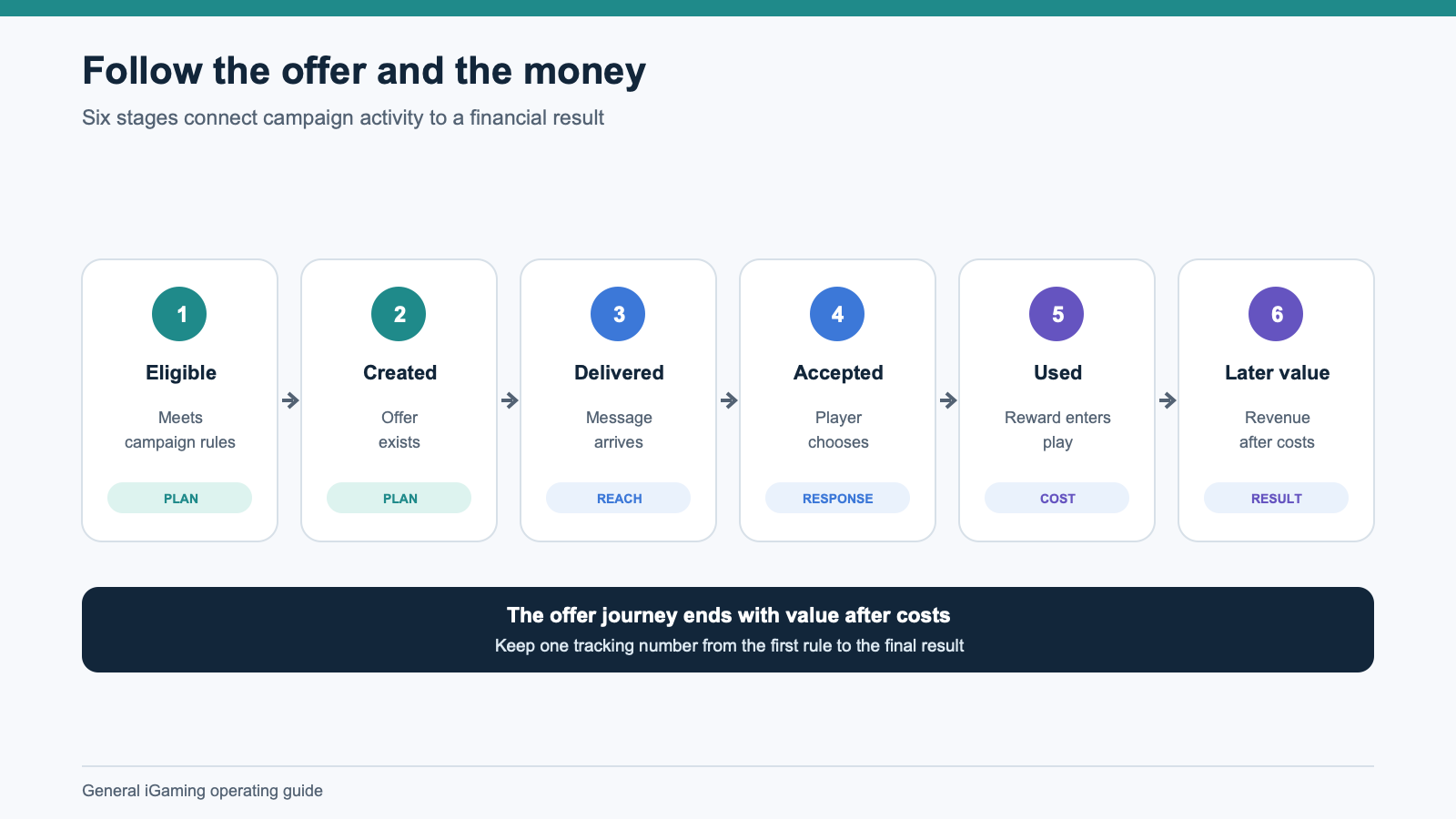
A campaign needs one tracking number from the first eligibility check to the final financial result. The record should show when the system marked a player as eligible, created the offer, delivered the message, recorded acceptance, applied the reward, and observed later activity. Each event needs a player identifier, campaign identifier, product, reward version, and time.
This chain helps the team find the actual problem. A low delivery rate points to contact data or channel health. Strong delivery with weak acceptance points to the message, terms, timing, or audience. Strong acceptance with little activity points to the journey after the click. High use with little value after costs points to the reward design. One blended rate hides these causes.
| Journey stage | Event to record | Decision supported |
|---|---|---|
| Eligible | Player passes campaign rules | Check audience size and exclusions |
| Created | Platform creates the offer | Check technical production |
| Delivered | Message reaches the channel | Check channel performance |
| Accepted | Player claims or activates the offer | Check response to the proposition |
| Used | Reward enters qualifying play | Check reward participation |
| Later value | Revenue and costs reach the report | Check the commercial result |
The money record needs equally clear fields. Headline offer value describes what the player may receive. Bonus-funded play describes stakes from the reward, which can include repeated use of the same balance. Winnings describe money returned through game results. Actual cost describes the effect that finance records under approved rules. Revenue describes the gambling result after winnings and the approved treatment of rewards.
| Money field | What it records | Common reporting error |
|---|---|---|
| Offer value | Maximum or advertised reward | Treating the headline amount as actual cost |
| Bonus-funded play | Stake activity from the reward | Treating wagering volume as revenue |
| Winnings | Returns from game outcomes | Omitting the effect on gambling revenue |
| Actual reward cost | Finance-approved campaign expense | Mixing cost methods across campaigns |
| Gaming revenue | Gambling result after winnings | Treating deposits as revenue |
| Contribution | Revenue left after direct costs | Excluding players with zero activity |
The operator should match player totals with finance and explain every difference. The operating rule is to keep the offer journey and money journey connected and give every field one meaning.
3. Use a fair test to control the budget
A larger reward raises campaign cost immediately. A fair test can show whether player activity and revenue rise enough to cover that increase. The team can keep the audience, timing, message, and product stable so the result reflects the reward change.
Two land-based studies report weak economic results from larger free-play offers. Lucas found that major increases left visit frequency and player-funded losses largely unchanged. Lucas and Nemati found that each of six player groups recovered less than the stated reward value. These findings support smaller tests and strict budget limits. Their land-based setting limits their use to caution and test design for online campaigns.
Random assignment provides the clearest comparison. Place players who pass the rules into an offer group or a usual-service group by chance before delivery. Keep the message timing, entry window, product, and time period stable. Continue essential support and player protection for every player. Kohavi and colleagues explain how this method can measure whether a change caused the result.
The report should compare the average value left per assigned player. Keep players who ignore the offer, face delivery failure, or leave the reward unused in their original group. This full-group view captures delivery, acceptance, use, and cost within one commercial result.
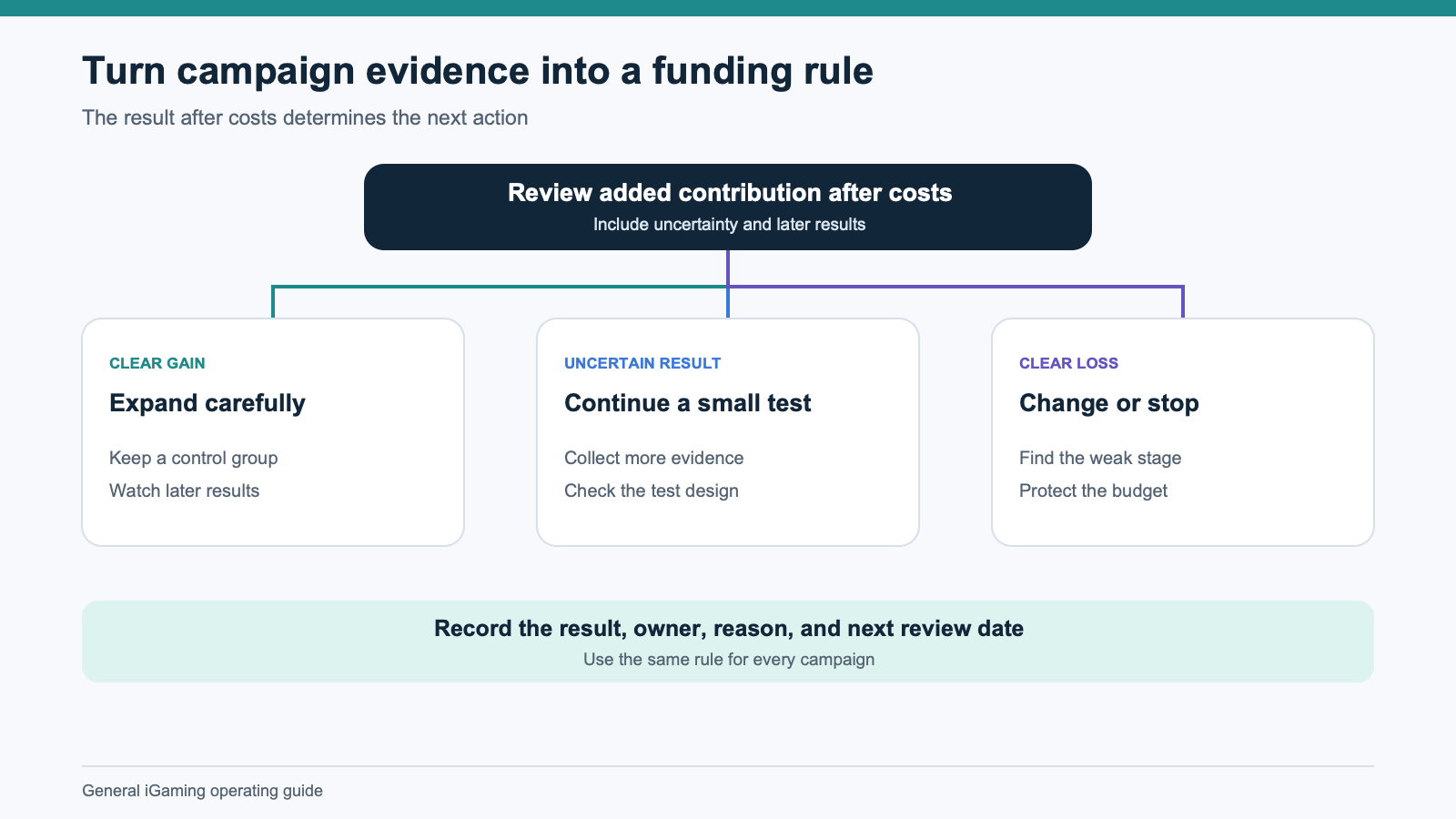
| Result | Meaning | Budget decision |
|---|---|---|
| Clear gain after costs | The offer group creates higher contribution | Expand carefully and keep a control group |
| Uncertain difference | The result may come from chance | Continue a limited test or improve the design |
| Clear loss after costs | The added value does not cover the campaign | Change the weak stage or stop spending |
The first review should occur at the planned campaign end. A later review should check whether the offer created extra activity or moved activity forward from a later period. The report should show the likely range around the difference, reward cost, complaints, opt-outs, technical failures, and any unusual gambling outcomes that dominate the total.
The operating rule is to base scale decisions on the added value measured in the test.
Put the bonus framework to work
The complete workflow fits into a short campaign brief and a repeatable review. Define the player action and financial result. Apply current eligibility and player protection checks. Track the offer through delivery, use, cost, and later activity. Compare the offer group with usual service. Record the evidence and the next budget decision.
| Review step | Owner | Required output |
|---|---|---|
| Goal and audience | CRM and product | One action, one group, one period |
| Reward and cost rules | CRM and finance | Approved value and accounting treatment |
| Delivery and event tracking | CRM and engineering | Complete event chain with one campaign ID |
| Test and analysis | Analytics | Contribution difference and uncertainty |
| Funding decision | Budget owner | Expand, revise, or stop with a review date |
The operator should apply this workflow separately by product, reward type, market, and important player segment. It should keep finance definitions stable across tests. Every decision should record the result, the limitation, the owner, and the next review date. This record helps later teams avoid repeating an unsupported assumption.
Frequently asked questions
Does a high bonus acceptance rate show success?
No. Acceptance shows that players claimed the offer. Compare contribution with a usual-service group to estimate the added financial value.
Should the report use deposits, GGR, or NGR?
Deposits describe account funding. GGR describes the gambling result before many direct costs. Use the finance-approved measure that subtracts every campaign cost once and apply it consistently.
How long should a bonus test run?
Use a period that can capture the target action, then review the same players again later. The later view helps identify activity that moved forward instead of increasing.
The operator should fund offers according to the additional value they create after costs.
Sources and evidence
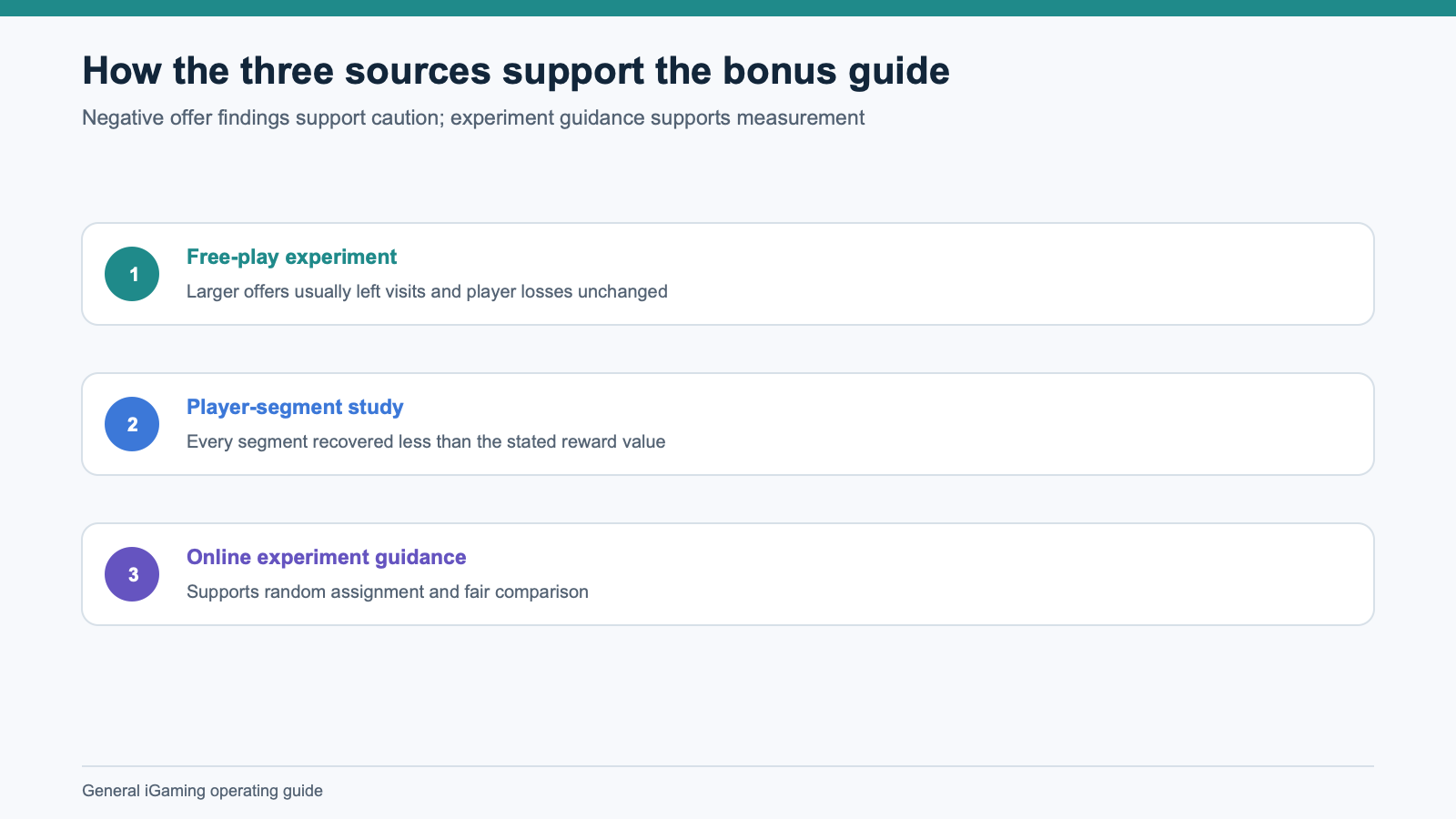
- Lucas, Impacts of Increased Free-play on Casino Revenue and Visitation, Journal of Gambling Business and Economics, published February 2026
- Lucas and Nemati, Free-Play Impact by Customer Segment, International Journal of Hospitality Management, 2019
- Kohavi and colleagues, Controlled experiments on the web, Data Mining and Knowledge Discovery, 2009