
A new player makes a first deposit, plays once, and disappears for the rest of the week. The customer marketing team sees an inactive account and prepares a bonus. The payment team sees a failed second deposit. Customer support sees an unresolved question. Each team has part of the story, so a bonus may reach a player who needs account help. The first seven days matter because they reveal these problems early in the relationship.
The practical answer is simple. Start the clock at the first successful deposit. Review a small set of player signals each day. Resolve service problems before sending a promotion. Test any message or reward against usual service. Judge the result through revenue after direct costs. This process turns the first week into a series of clear decisions.
Key takeaways:
- Use the first successful deposit as Day 0 for every player.
- Track payments, active days, recent activity, support needs, and open rewards.
- Match the next action to the latest player facts.
- Fund retention work according to contribution after costs.
1. Know what the first week needs to earn
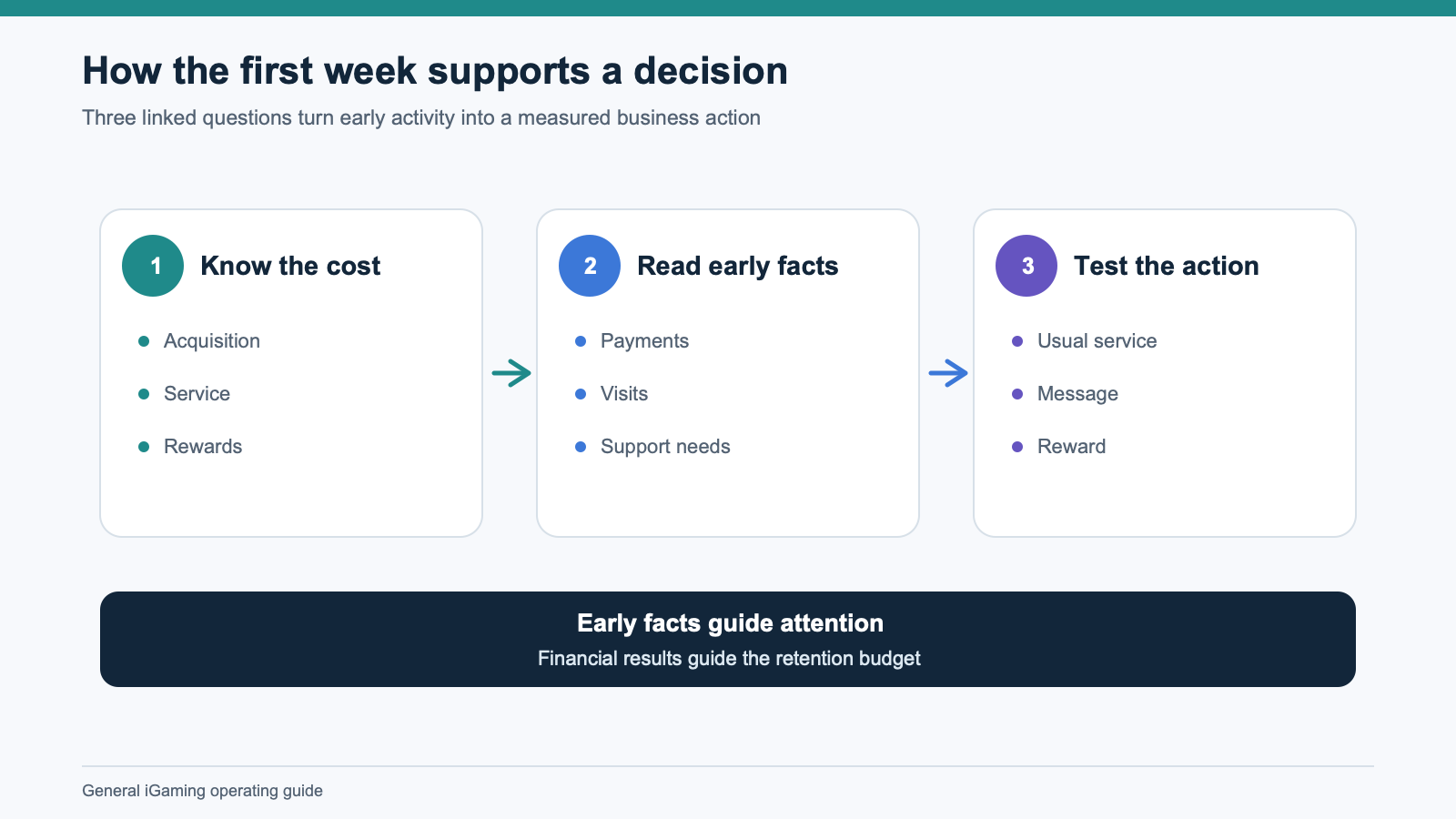
By the end of a player’s first session, the operator may have paid an acquisition fee, issued a welcome reward, processed a payment, and provided support. A first-week plan can connect this spending to a clear player action and a defined commercial result.
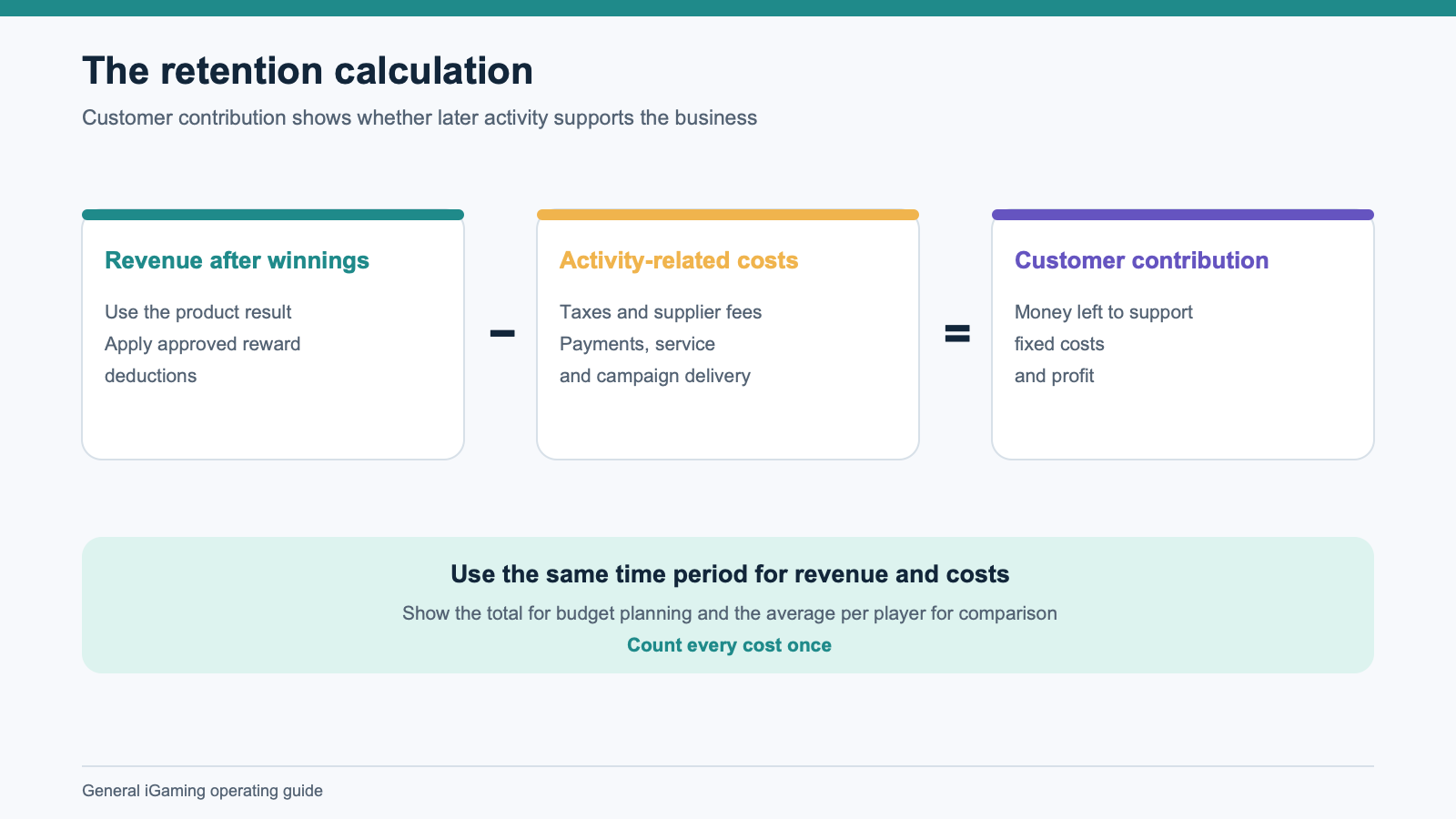
A deposit shows how much money entered the player’s account. Gaming revenue shows the financial result after play, winnings, and the approved treatment of rewards. Finance can give every retention team one shared revenue definition.
The team can subtract rewards, gaming taxes, supplier fees, payment fees, and campaign costs from revenue. The remaining value shows how much the player relationship contributes to the business. Teams can use this measure to expand, improve, or close a retention campaign.
| Money field | Plain meaning | Decision use |
|---|---|---|
| Deposit | Money added to the player account | Shows funding activity |
| Gaming revenue | Gambling result after winnings | Shows product revenue |
| Reward cost | Approved cost of the player incentive | Shows promotional expense |
| Direct operating costs | Costs linked to play, payment, or contact | Completes the commercial view |
| Customer contribution | Revenue left after direct costs | Guides retention spending |
Finance can apply the same definition to every player group. The report can show total value for budget planning and average value per assigned player for campaign comparison. A seven-day result can guide the next action, and a thirty-day result can guide the longer-term budget.
This shared measure can connect player activity to a clear budget decision.
2. Turn first-week signals into the next action
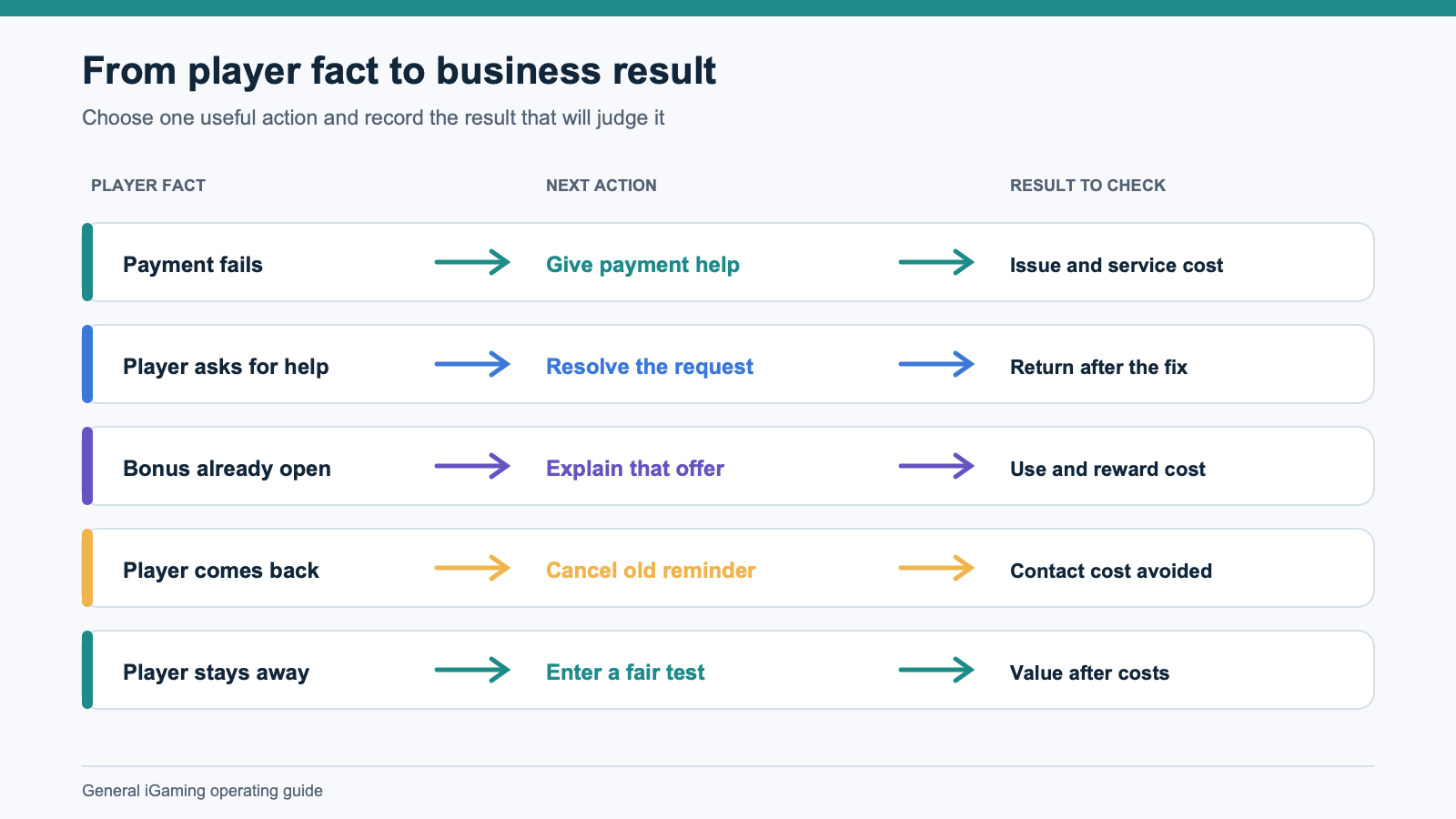
The first-week review does not need a large predictive model. It needs current facts that change the next action. A failed payment points to payment support. An open support request points to service. An unused reward may need a reminder or clearer terms. A recent return removes the need for a recovery message. An inactive player with no open problem may qualify for a controlled campaign.
| Signal | What it can reveal | Useful next step |
|---|---|---|
| First successful deposit | The common Day 0 | Start the first-week clock |
| Active days | Whether real-money activity continued | Review the player journey |
| Latest activity time | Whether a planned message is still relevant | Send, delay, or cancel contact |
| Failed payment | A possible access or payment problem | Offer payment help |
| Open support request | An unresolved service need | Resolve the request first |
| Open reward | An offer already available | Explain the existing offer |
Research supports the use of behaviour for this review. Coussement and De Bock used two years of real activity from a large online poker operator to rank players by their chance of leaving. Their work shows that past activity can help operators decide which accounts deserve attention. Jolley, Mizerski, and Olaru found that past play frequency had a stronger relationship with retention than reported satisfaction in their online gambling study. These studies support player selection.
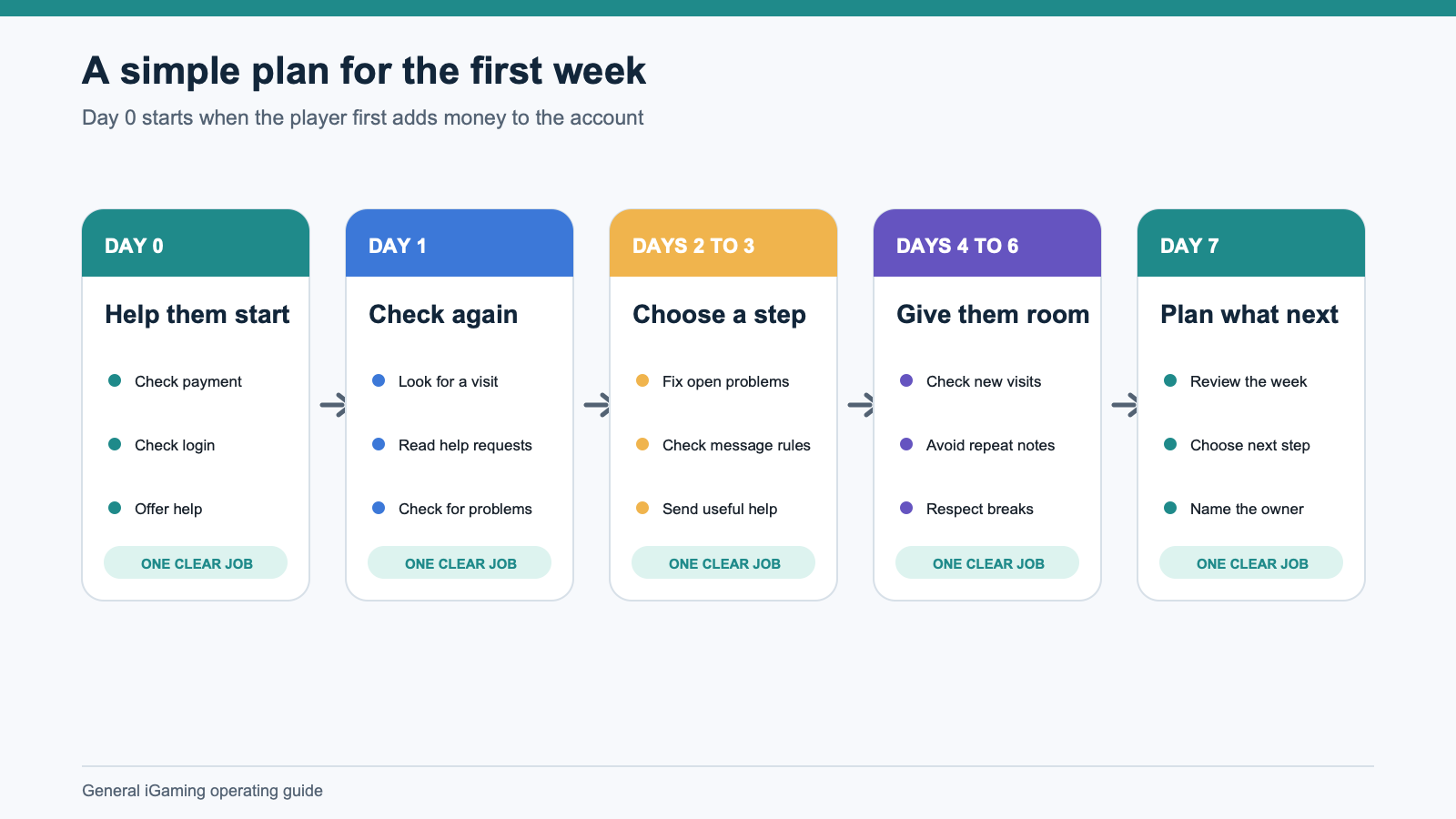
A simple schedule helps several teams work from the same account state. Day 0 should confirm that the deposit, login, and first playing experience worked. Day 1 should check whether the player returned and whether a service issue remains open. Days 2 and 3 should resolve problems and consider one useful message. Days 4 to 6 should update the player state and cancel outdated contact. Day 7 should assign the next owner and decide whether the player leaves the welcome journey, enters a test, or receives no further action.
| Window | Main review | Decision |
|---|---|---|
| Day 0 | Payment, access, first activity | Fix the start of the journey |
| Day 1 | Return activity and open issues | Continue service or observe |
| Days 2 to 3 | Current eligibility and permissions | Send one useful message when suitable |
| Days 4 to 6 | New activity and campaign overlap | Update or cancel planned contact |
| Day 7 | Full first-week result | Assign the next journey and owner |
The schedule is a starting framework. Casino players, sportsbook customers, and poker players can follow different rhythms. A weekend bettor may appear inactive during the week. A poker player may wait for a scheduled tournament. Each operator should test the timing by product and market and keep the decision logic stable.
The operating rule is to use the smallest set of signals that leads to a useful action.
3. Test the message before you scale it
A player can return for several reasons, including product interest, a scheduled event, or earlier support. A fair comparison can isolate the value created by the campaign. This gives the team a stronger basis for the next retention budget.
Message wording and timing can shape the response. The team can test each message with a defined player group, time period, and commercial measure. Player-protection rules, contact permissions, and service needs can guide who enters the test and when contact ends.
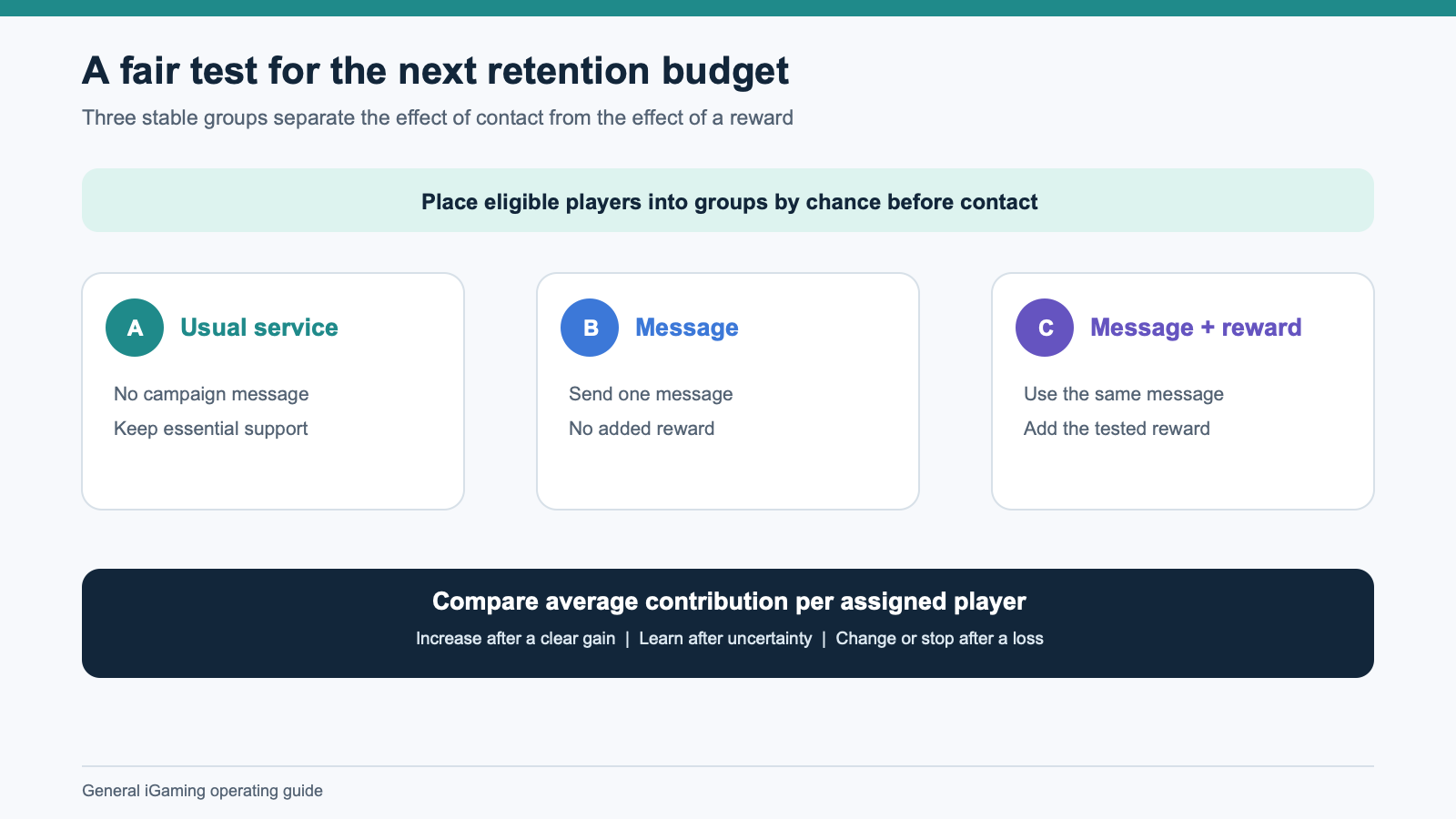
Use three groups when the team wants to separate the effect of contact from the effect of a reward. Place eligible players into groups by chance before any message goes out. Keep essential service and player protection active for everyone. Keep each player in the assigned group when reporting the result, including players who ignore the message or never use the reward.
| Test group | Experience | Question answered |
|---|---|---|
| Usual service | No campaign message or reward | What happens without the campaign? |
| Message | One message with no added reward | Does contact create value? |
| Message and reward | The same message with the tested reward | Does the reward add enough value? |
Kohavi and colleagues explain how random assignment helps online businesses measure whether a change caused an observed result. The team can compare average customer contribution per assigned player after the same period. An early review can show the first-week response. A later review can show the value that remains after one month.
The report should include the difference between groups, the likely range around that difference, reward cost, complaints, opt-outs, and unusual gambling outcomes. A clear gain after costs can support a careful increase. An uncertain result supports a longer or better test. A clear loss supports a change or stop decision.
The operating rule is to let measured additional value decide the next budget.
Put the first-week playbook to work
The full process can run as one weekly operating loop. Start with the current account state. Route payment and support problems to the right team. Remove players who already returned from recovery campaigns. Place suitable inactive players into a controlled test. Compare contribution after costs. Record the decision and use the result to improve the next first-week journey.
| Review question | Owner | Output |
|---|---|---|
| Did the player complete payment and access? | Payments or product | Resolved issue or clear account state |
| Does the player need support? | Customer support | Closed request and service outcome |
| Is commercial contact permitted and useful? | CRM or compliance | Eligible audience with current exclusions |
| Did the action add value after costs? | Analytics and finance | Increase, revise, or stop decision |
The system should repeat account, marketing permission, and player protection checks immediately before contact. It should also record who changed a rule, why the rule changed, and when the team will review it again. This record turns separate campaigns into a process that learns.
Frequently asked questions
When should the seven-day clock start?
Start at the first successful real-money deposit. This event gives payments, CRM, finance, and analytics one consistent Day 0.
Should every inactive new player receive a bonus?
No. Review payment failures, support requests, open rewards, current activity, marketing permission, and player protection status first. Use a fair test for players who remain suitable.
What should the team report after seven days?
Report service outcomes, active days, campaign assignment, direct costs, and customer contribution. Review the same group again after a longer period before changing a long-term budget.
Early signals should guide attention. Measured financial results should guide retention spending.
Sources and evidence
- Coussement and De Bock, Customer churn prediction in the online gambling industry, Journal of Business Research, 2013
- Jolley, Mizerski, and Olaru, How habit and satisfaction affect player retention for online gambling, Journal of Business Research, 2006
- Kohavi and colleagues, Controlled experiments on the web, Data Mining and Knowledge Discovery, 2009